Museums are like a documentary that you can walk yourself through in your own time. Seeing as there are a lack of museums in our current climate, I decided to go on a virtual tour of Natural History Museum in Washington D.C. Doing this helped me massively in understanding how facts can be displayed for our understanding.
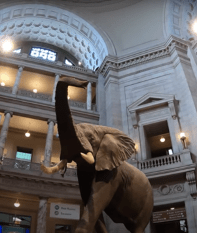
We start at the front entrance of the museum, and the first thing that we see is this enormous sculpture of a mammoth. You are instantly astounded by how it towers over you. In order to enforce this, you can see later in the video that the mammoth is actually stood on its own pedestal, so it stands even taller over the crowds of people as they enter the museum. I would imagine that this was done to frighten and amaze the audience that saw this so that they could try to comprehend that animals at one point where this incomprehensibly large. It’s also important to focus on how this is being displayed to audiences at home like myself taking the virtual tour, they very cleverly in this shot of the mammoth has it tower over the camera man, rather than having a wide shot where we wouldn’t truly understand how tall it stands.
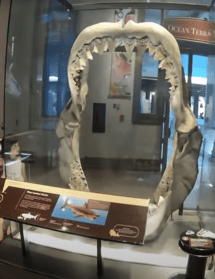
We have a similar display here, where we see the gaping jaws of an old species of shark. By having the jaws displayed wide open like this as if the skeleton of this shark is going to snatch you out of thin air, we as an audience to this display gain a far better understanding of just how large this animal was. In the background of this shot we can also see the next room following this display. The colour scheme of this room seems to be key for the audiences understanding of what the room is going to be displaying to them. By having the room shaded blue by the LED lights, as well as the ceiling itself, it immediately shows the audience to this museum that this room is associated with an underwater theme. We see this done throughout the museum tour as we go through each of the different eras, and species, the surrounding environment is artistly designed in order to represent the place that they belong.
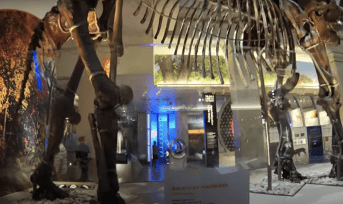
This is similarly done with the dinosaur exhibit within the museum, as you can see there are trees pictured behind the dinosaur so as to educate the audience as to where in the wild, we would have found this species of dinosaur. There are also large windows in the background showing the trees outside to give a better feel of nature within the indoors. Having only a small amount of natural light in this room is extremely beneficial to the exhibit as it allows them to gain more control in how they control the light around these fossils. There for, they control our perception of them. For example, the lights that shin onto this dinosaur, are all pointing upward toward it. By doing this it allows us to gain the best view of the fossils as we will be looking at them from bellow due to the size of the creature. But it also makes the animal appear even larger, by having long shadows scaling up the bones.
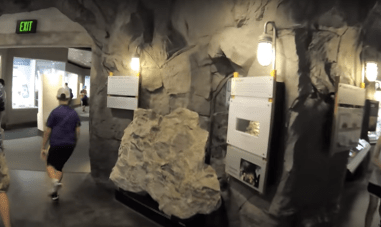
One last thing I noticed about this museum in how it has been cleverly constructed to keep audiences entertained throughout the entire tour, is that they don’t show you the most exciting aspects of the museum straight away. For example, whilst we are enticed near the beginning of the tour with the displays of dinosaurs (something this museum is well known for), its then keeps us more and more curious throughout. How I noticed they did this was by making the museum appear more and more interactive as you went through, so you start off simply watching things in order to learn, but this then slowly shapes into you doing things like moving through replicas of caves, or going into dark rooms to see the glowing effects of certain rocks and fossils etc…
What I can take from this virtual tour and apply to my own documentary?
The first thing I can take from this experience is the use of camera angles in order to benefit the point I am trying to put across within my documentary. I’ve learned that a camera angle can tell the audience whether the person on screen is trustworthy or not, something that is important to keep in mind when making something about real life. Similarly, I realised that lighting can also have a large impact in this same way. The way that I will apply this to my work when it comes time for me to start shooting, is I will re-watch clips of what has been filmed, and look at how I am interpreting the people on screen, and the ponder the question as to whether or not this is something that needs to be changed. I can also use this aspect to exaggerate facts to a certain extent. What I mean by this is like how the put the mammoth onto a platform to make it appear taller, the audience still knows that this is happening, but it also helps them to understand the sheer height of this animal. How I could do this in a documentary is by simply exaggerating a fact to its absolute max, without needing to change the truth behind the fact in any way. By doing this it will not only keep my audience engaged with my subject, but it will also exaggerate the fact far enough that it is still hard hitting, even though they are watching it through a screen
I also learned that I need to find a way to keep my audience interested and intrigued throughout my documentary. Whilst I have no way to make my documentary interactive in the way that a museum can, I do still have the ability to hold off on the most interesting parts of my documentary. For example, if the whole of my film is leading up to the answer to one question, by simply hinting at what the answer could be throughout, whilst not actually answering anything until the end of the documentary, I will be keeping my audience enticed, whilst simultaneously giving them information and educating them.

