The documentary Community FC, follows the manager of a football team as it educates us on what his role is, and how Covid-19 has affected his role as a manager.
The film starts with an interview with Ellis (the football team manager). This is a great place to start as it allows us to instantly get an idea of the type of person that he is. By having Ellis situated in what is clearly a student setting through the clever use of Mise en Scene, we as an audience immediately interpret that this is a student we are chatting with. For example, we have a pull focus shot at the beginning of the film that moves from an open pouch of tobacco, to Ellis playing football in the background. The film is very informative as it gives information not only on how things used to be run prior to Covid-19, but it also educates us on how things are being run now in our current social climate. The reason that this information is useful for the audience to interpret is because it is what gives meaning to the unfortunate current situation and will therefore make the audience empathise for our main character.
I feel that there is a real emotional side to this film as it touches on the mental health issues that the players are having to deal with by not being able to meet up and do the thing that they love, the way that they used to do it. This is shown through the dialogue gained from the interviews, but also through the scenes where we see the actual football match and the training session. By overlapping the dialogue where it is the manager talking about the fact that they are still doing what they can when they can, over the top of some shots of everyone still making a solid effort and training together in any way they can, it shows the audience just how much they need football, which is what makes it all the more sad to watch as it is not even being played to its best potential.
Seeing as our documentary idea has now formed around the idea of how a football team is able to cope with the hurdles that accompany Covid-19, it is only fitting that our postproduction processes themselves have taken a hard hit on that front. However, we have thankfully managed to pull together as a group and come up with new ways to go through the stages we would usually go through had we been able to make this film normally.
One of the main aims for our group that we wanted to enforce was the ability for everyone in the group to be able to share their opinion based off the footage that was obtained. How we originally wanted to do this was have our camera man upload all of the clips that they obtained at the shoot to a google drive, so that we could all then go home and watch through the clips on our own devices. This unfortunately did not prove to work as our camera man did not have strong a enough internet connection to upload all of the clips. What we did instead was we had to have the camera man go through all of the clips themselves and select what he thought were the best ones, cut them down to a length of time that could be easily uploaded, and then the rest of our group would be able to see that obtained footage and clarify whether or not they are happy with it. Whilst this did prove to be a tricky process, I am still grateful that we were able to at least see the final footage as a group before we put it into the final artefact itself. One useful thing that did come from doing this was that we realised that we didn’t have enough footage of the team actually playing football. This is something that we could have easily missed had it all been reviewed by one person alone.
When making a documentary, it seems that the best way to get the most raw and down to earth interpretation of the “real” people and situations you are filming them in, is to firstly make sure that you have done plenty of research on the topic you will be filming. This appears to be a vital step, because the only way you are going to know what the most important aspects of your documentary are going to be, is if you can get yourself into the mindset of not only the audience that is going to be watching your documentary (so that you can interpret what your target market will want to see), but it will also help you get onto the same wavelength as the person that you are filming. This could be helpful for many reasons. For example, if you were making a film about an Olympic Athlete, at first glance you may think that the main body of this film will be about what it is like for them to perform under the heavy pressure of an event as public as the Olympics. However, if you put yourself into their mindset and researched into what your target audience would really like to see, then you would soon realise that the majority of this documentary would be better spent looking into the time leading up to the Olympics. Researching into this topic beforehand would show you this because you would see that the target audience for a documentary about an athlete, will likely be people that want to be inspired to bring aspects of physical exercise into their own lives. How we would make this film appealing to this audience is by demonstrating the athlete as someone that is achieving a goal that anyone could also achieve if they worked hard enough. This would mean avoiding showing the athlete doing things that only he would have access to, (like training in large stadiums for example), and instead show montages of them going running, in the gym, or just simply showing how they diet themselves in preparation for the event.
Another way of making a documentary more relatable to “real” people and situations, is by having your main character talk about what their life was like before they had any success in what they now do. A good example for this is if you were making a film about a famous musician. You want to spend the majority of the film documenting this person’s crazy lifestyle, showing the good and bad of constantly being on tour as well as what it is like dealing with fame. However, in order to entice the audience by making them believe that this is something that they too could one day achieve, you would need to try and ground whoever it is that you are filming. This may be easier said than done, seeing as we are talking about a famous musician who could be seen as a god to certain hardcore fans. Nevertheless, giving fans an idea of how this person used to lead their life before fame, would remind them that at one point this person was just an ordinary individual like themselves. The reason that fans would want to see this is because it will give them the aspirations to bet on themselves just as the musician did, and hopefully inspire your audience to take action. All of this inspiration could easily stem from you simply taking the time to ensure that you make the main character of your film as relatable as possible.
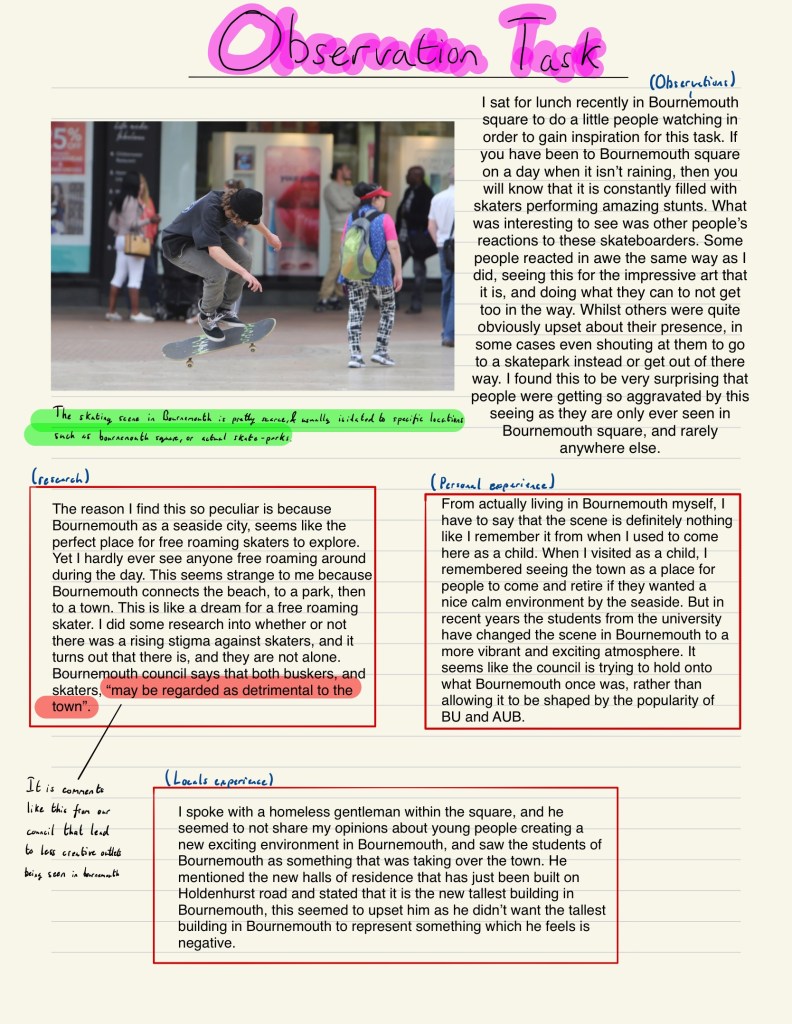
For the first stage of my personal pre-production process, I had to take on the task of coming up with an idea by going somewhere in Bournemouth and observing the people and the area around me. This is how I ended up coming up with my original idea to do a documentary about the skaters. Whilst this was a helpful task to complete because it allowed me to prove to myself that I was easily capable of coming up with my own ideas, I wish that I had given myself multiple different ideas to work with rather than just one. Giving myself more ideas would have been helpful to do because that way I would have back up plans for if something were to stop me from being able to film my original idea. This is something that I am definitely now wearier of seeing as I have found myself now in a situation where I cannot film my original idea because of the current situation with Covid-19 and the national lockdown.
Seeing as I am in a group of 4 and we could have legally seen each other before the lockdown, I would have liked to have met with all of them in person before we started to do our work together. I obviously would have met up with them eventually if it weren’t for the lockdown, but my lesson I have learned for next time is that this is not something that I should write off to do later. I feel it is vital to meet with your group before starting any of the work, just so that you can simply get to know each other a little bit before you start to work together. Luckily, other members of the group agreed that we should know each other a little better before we start working together on something so important. It is for this reason that we thankfully decided to have a few zoom calls near the beginning of our production process. This started out as a getting to know each other sort of session, but eventually formed into us brainstorming potential ideas.
This documentary follows correspondent A.C. Thompson as he shows us the awful violence that took place at the largest gathering of white supremacists in a generation. This is a POV styled documentary so for a lot of the scenes in the film I found it very hard hitting in that it felt as though I was on the front line with the protestors fighting against the weaponised and angry racists.
For the first two minute of the film the footage is made up only of shots of the actual event. These aren’t the sort of shots that you would expect for a documentary like this one. A common trope for films documenting tragic events usually is that it will be shown through poor quality security cameras, or even re-enacted if they have no footage, and only stories of the event that took place. The reason this one is so well documented is because it is sadly an event that has taken place fairly recently, at a time when everyone in the world has a mobile phone camera in their pocket at the ready to film anything. For this reason, this documentary is shot from all different angles during the event. It also means that the film is being shown to the audience from both the KKKs point of view, as well as the protestors point of view. The event being filmed from so many different angles, and by so many different people is also very advantageous in that it is easy to tell the fake footage from the real footage. This is because the real footage van be backed up by the fact that it is visible from other witnesses. By having the first two minutes of the film only showing the tragic violence on the frontline of it all, it immediately prepares the audience for how hard hitting this documentary is truly going to be. It also immediately shocks the audience by showing the brutality of what took place in its full and not hiding anything. It is vital that the film be shown to us in this way. This is because after watching this film, it is very clear that it was made for a purpose, it was made to inspire change through its audience, and it will certainly evoke emotions that could push for movement by showing us the brutality of the protest that took place in Charlottesville.
After showing us this the documentary then very cleverly shows us a march that took place that same weekend and explains that all of the footage was caught by one person, Emily Gorsenski. Here we start off seeing the footage that she managed to obtain of the members of the KKK marching towards her and her group of activists, and then we see cuts of what she managed to capture as 100s of racists began to physically attack her and her friends. After this we then see an interview between Thompson and Emily where she further explains the footage that we just saw. By showing us this violent act of terror that she had to go through, and then listening to her account of what happened, it gave the audience a clear understanding of what took place that night. It also cleverly cut in and out of the footage that she obtained whilst keeping the audio of her interview constant. Doing this helped to show the audience just how hateful these people are, because it shows us that Emily’s character is good natured, and forces us to empathise for her as we begin to gain the knowledge that none of the people that got attacked actually did anything wrong at all.
The part of this film that does a great job of hitting the audience the hardest is the scene where it details the one death that took place during the most publicised terror event of that day in Charlottesville. This was when James Alex Fields Jr. selfishly drove his car through crowds of people injuring 28 and killing 1. What is so terrifying about the documentation of this event is that it is truly POV. It isn’t like you are just watching the event from afar but close enough that you still feel like you’re a part of it. There is an abundance of camera shots from people that were actually hit by the cars themselves and gained almost critical injuries. Whilst this is very hard to watch, it sets you up perfectly for the next scene in which we witness an interview between Thompson and the mother of the one person that was murdered during the event. Doing this evokes such emotion such as empathy and sadness, but it also makes the audience very angry, and then directs this anger at the KKK, as it should.
It is at this point that I came to the realisation that the narrative of this film was clearly directed at getting people to fight against racism through who they vote for at the next election. This became clear to me because placed fairly close to the scenes where it displays the terrorist act that lead to the innocent death of the protestor, it shows how trumps support for the white supremacy movement has been a large reason as to why these events have ended up being able to take place. By doing this it makes the audience presume that this wouldn’t have happened If it wasn’t for Trump being president. It is for this reason that I feel that this documentary’s narrative may have been directed at influencing its audience in who they should vote for.
Towards the end of the film it begins to research into one man specifically Vasili Pistolis, and his involvement in the white supremacy movement. It is discovered that this man is actually in the military. The documentary then very cleverly uses this as a jumping off point and starts to divert the audience’s attention to whether of not this is a common trope of people within the KKK. And at this point in the narrative it then forces the audience to question whether or not it is easy for someone as racist and violent as this man to get into the military.
When I was 19 years old my family and I found ourselves in what could have been a life threatening event. The year was 2019, and we were drawing to the end of our skiing holiday in Switzerland. It was an overcast day, but as it was our last day there, we decided that we would go to the top of the mountain for some skiing in order to make the most of it. We got the train up the mountain early in the morning and managed to ski with no problems for the first few hours. We noticed the clouds slowly fill the entire blue sky but chose to ignore it and continued as normal. We were on a ski lift going back up to the very top of the mountain when we noticed that the winds were so strong that they were moving the entire ski lift backwards rather than forwards. Luckily the lift still managed to carry us up to the top of the mountain harm free, but as we had never seen winds that strong before we decided that we would get the train down instead of skiing. We walked with all our ski gear to the station that is situated at the peak of the mountain, only to be informed by one of the train guards that there was a snowstorm slowly covering the top of the mountain, and the trains that are built to withstand this kind of whether couldn’t even hack it. We were then left with two options, we could either stay in the train station and wait for several hours for the storm to pass over, or we could slowly ski down the mix of red and black runs in the midst of one of the strongest snow storms the ski resort has ever had to face. After a lot of discussion, and a fair few tantrums from my younger siblings who were rightfully terrified, we decided that we couldn’t miss our flight, and so we would ski down the mountain through the storm. We put all of our gear on, and the second we stepped outside I saw my dad smack down to the floor due to the unexpected wind furiously pushing us aside. This sent my younger brother into hysterics, but we managed to calm him down eventually getting him outside with the rest of us. My dad led us single file down the mountain, with myself at the very back to make sure that no one split off from us. The mix of harsh wind and violent snow was forming icicles to grow on my beard, and freezing my lips shut. Due to the pain I was experiencing from this I stopped for a second to try to warm may face with my hands, I looked up and realised that I could no longer see any of my family. This was because the wind and snow was so strong, mixed with the pale white sky everything in our line of vision was completely invisible unless it was less than a few metres in front of us. I quickly composed myself and began to take long stretches from side to side of the mountain as I made my way down by myself, hoping to find my family again. I continued this method of stretching across the mountain in order to find them for a while before I ended up finding my sister on the floor in the snow. I swiftly got her back onto her feet and screamed through the loud wind for her to stick to me like glue as we continue down the mountain. She gestured in a certain direction screaming something, but I couldn’t hear what she was saying over the snow storm, she began to ski off in a different direction and I quickly followed her, I was then extremely relieved to then find the rest of my family slowly skiing towards the clear end of the snow storm.
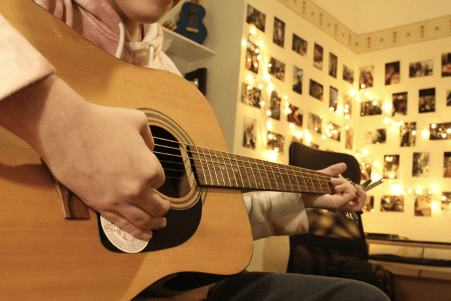
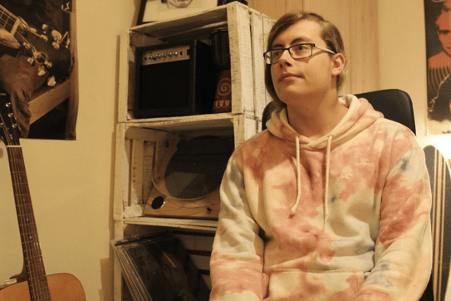
In order to analyse the best way to demonstrate someone’s attachment to an object that they care about deeply, I decided to use the example of a guitarist for if I were making a documentary about a musician. I wanted to take two photos, one that would represent footage that could be used as B-roll footage of this person playing on the guitar and using it, and the other for the interviews and how I would want the set around him to look in order to portray this person’s infatuation with this one particular object.
In this first image we can see them playing on the guitar. The reason that we can see this person’s attachment to the object is firstly through the angle of my shot. By having the camera at a low angle situated toward the end of the guitar, it ensures that the guitar is taking up most of the frame. I wanted to do this to show the importance of the guitar in his life. The guitar takes up most of his life, as it does the shot.
Another thing I paid attention to when taking this picture was my focus point, rather than making focus point his hand playing the guitar, I drew the attention instead to the centre of the guitar. This way the audience is as is sharing the amount of focus that our main character has for this object. Whilst this is subtle to notice, if I had a proper lens for my camera then this idea would be far more effective.
The next thing I did is extremely subtle but still necessary. I ensured that there was a prop of some sort in the background that helped to demonstrate the fact that music is such a large part of this person’s life. The prop that I chose was a Ukulele. I figured that it is a perfect direct representation of his passion for music, and in particular, the guitar.
This photo is how I would have him staged for any interviews that I wanted to do with him. As I did in the previous photo with the Ukulele, I wanted to make sure that the Mise en scene in this shot all pointed towards his love for music and guitar. So, to do this I stacked up some old apple boxes to use as shelves and filled them with all the musical objects I could find to create a nice backdrop. I also had the guitar we saw in the previous shot resting on the wall to show it as if it is something that he is never without.
This is similarly seen in most documentary’s about musicians, where the backdrop to an interview will be an old stage, or a recording studio. It is about keeping the audience constantly in an environment that suits the theme of the film.
The ocean drives global systems that make the Earth habitable for humankind. Our rainwater, drinking water, weather, climate, coastlines, much of our food, and even the oxygen in the air we breathe, are all ultimately provided and regulated by the sea. Careful management of this essential global resource is a key feature of a sustainable future. However, at the current time, there is a continuous deterioration of coastal waters owing to pollution, and ocean acidification is having an adversarial effect on the functioning of ecosystems and biodiversity. This is also negatively impacting small scale fisheries.
Coastal seas
I recently watched the coastal seas episode from the documentary “Our Planet”. The episode gave amazing insights as to what life was once like in the ocean, what it is like today, and what it will be like in the future. It is clear that this episode is doing everything it can to help educate its audience on the sustainable UN goal of life below water. This is evident immediately through the blurb alone from the documentary, where it says, “Protecting these habitats is a battle humanity must win”. This episode so brilliantly educates us whilst keeping us entertained. How it does this is by keeping us engaged visually with stunning cinematography, picked up on high quality cameras, whilst we audibly here Sir David tell us consistently interesting facts about the life that we are seeing on screen. The documentary then cleverly gives us a plethora of information looking at all sides of the argument for more ocean life preservations. It starts showing us the ocean as it is, doing this keeps us engaged as this is what we first expected of the episode. However, it then goes on to show us what the ocean used to be like, how it is now, and how it will be in the future. Seeing the devasting news that unless we see a change in how we treat our oceans we may see a large drop in life underwater is terrifying to see. This is when the documentary then shows us how well this could all turn out, it does this by showing us the underwater life of a preserved water space where the fish are able to roam freely without our interruption. It is after we see these glorious shots full of life and colour, that sir David then announces the shows partnership with WWF and urges us to not only donate to the cause, but also to further educate ourselves on how we can help with this sustainable goal.
Museums are like a documentary that you can walk yourself through in your own time. Seeing as there are a lack of museums in our current climate, I decided to go on a virtual tour of Natural History Museum in Washington D.C. Doing this helped me massively in understanding how facts can be displayed for our understanding.
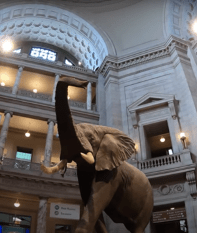
We start at the front entrance of the museum, and the first thing that we see is this enormous sculpture of a mammoth. You are instantly astounded by how it towers over you. In order to enforce this, you can see later in the video that the mammoth is actually stood on its own pedestal, so it stands even taller over the crowds of people as they enter the museum. I would imagine that this was done to frighten and amaze the audience that saw this so that they could try to comprehend that animals at one point where this incomprehensibly large. It’s also important to focus on how this is being displayed to audiences at home like myself taking the virtual tour, they very cleverly in this shot of the mammoth has it tower over the camera man, rather than having a wide shot where we wouldn’t truly understand how tall it stands.
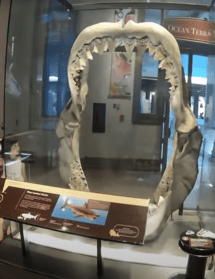
We have a similar display here, where we see the gaping jaws of an old species of shark. By having the jaws displayed wide open like this as if the skeleton of this shark is going to snatch you out of thin air, we as an audience to this display gain a far better understanding of just how large this animal was. In the background of this shot we can also see the next room following this display. The colour scheme of this room seems to be key for the audiences understanding of what the room is going to be displaying to them. By having the room shaded blue by the LED lights, as well as the ceiling itself, it immediately shows the audience to this museum that this room is associated with an underwater theme. We see this done throughout the museum tour as we go through each of the different eras, and species, the surrounding environment is artistly designed in order to represent the place that they belong.
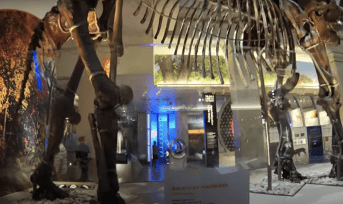
This is similarly done with the dinosaur exhibit within the museum, as you can see there are trees pictured behind the dinosaur so as to educate the audience as to where in the wild, we would have found this species of dinosaur. There are also large windows in the background showing the trees outside to give a better feel of nature within the indoors. Having only a small amount of natural light in this room is extremely beneficial to the exhibit as it allows them to gain more control in how they control the light around these fossils. There for, they control our perception of them. For example, the lights that shin onto this dinosaur, are all pointing upward toward it. By doing this it allows us to gain the best view of the fossils as we will be looking at them from bellow due to the size of the creature. But it also makes the animal appear even larger, by having long shadows scaling up the bones.
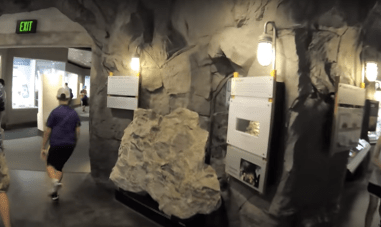
One last thing I noticed about this museum in how it has been cleverly constructed to keep audiences entertained throughout the entire tour, is that they don’t show you the most exciting aspects of the museum straight away. For example, whilst we are enticed near the beginning of the tour with the displays of dinosaurs (something this museum is well known for), its then keeps us more and more curious throughout. How I noticed they did this was by making the museum appear more and more interactive as you went through, so you start off simply watching things in order to learn, but this then slowly shapes into you doing things like moving through replicas of caves, or going into dark rooms to see the glowing effects of certain rocks and fossils etc…
What I can take from this virtual tour and apply to my own documentary?
The first thing I can take from this experience is the use of camera angles in order to benefit the point I am trying to put across within my documentary. I’ve learned that a camera angle can tell the audience whether the person on screen is trustworthy or not, something that is important to keep in mind when making something about real life. Similarly, I realised that lighting can also have a large impact in this same way. The way that I will apply this to my work when it comes time for me to start shooting, is I will re-watch clips of what has been filmed, and look at how I am interpreting the people on screen, and the ponder the question as to whether or not this is something that needs to be changed. I can also use this aspect to exaggerate facts to a certain extent. What I mean by this is like how the put the mammoth onto a platform to make it appear taller, the audience still knows that this is happening, but it also helps them to understand the sheer height of this animal. How I could do this in a documentary is by simply exaggerating a fact to its absolute max, without needing to change the truth behind the fact in any way. By doing this it will not only keep my audience engaged with my subject, but it will also exaggerate the fact far enough that it is still hard hitting, even though they are watching it through a screen
I also learned that I need to find a way to keep my audience interested and intrigued throughout my documentary. Whilst I have no way to make my documentary interactive in the way that a museum can, I do still have the ability to hold off on the most interesting parts of my documentary. For example, if the whole of my film is leading up to the answer to one question, by simply hinting at what the answer could be throughout, whilst not actually answering anything until the end of the documentary, I will be keeping my audience enticed, whilst simultaneously giving them information and educating them.

 Benjamin’s Blog